Teck Resources Limited
Student Researcher
Feb. 2024 - Jun. 2026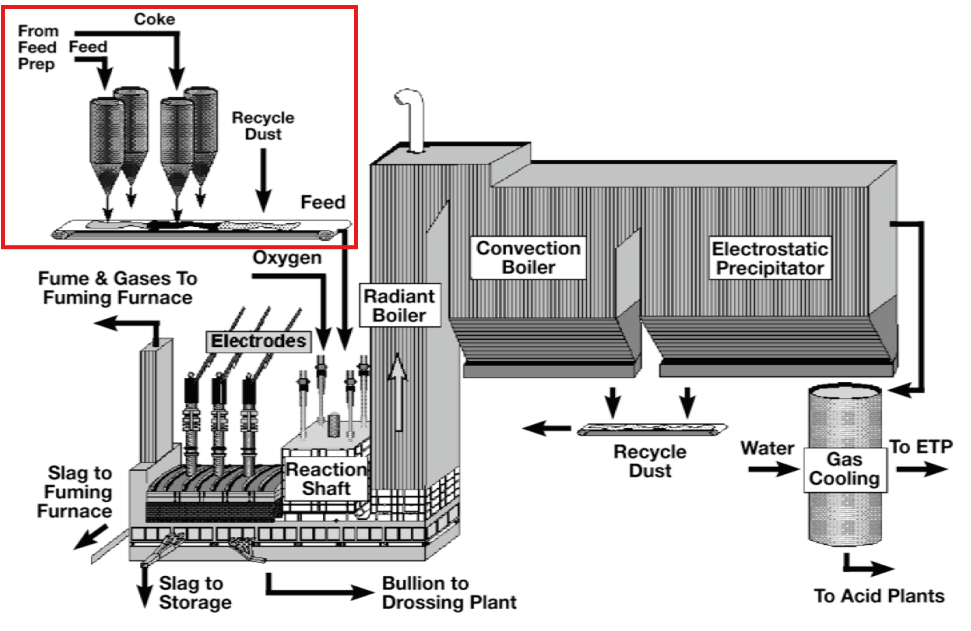
Industrial Data Analytics and Optimization with Teck Resources
From 2024 to 2026, I collaborated with process control engineers at Teck Resources on two industrial projects at the Trail metallurgical operations. The work focused on applying data analytics, machine learning, optimization, and process-control methods to real plant problems.
My role involved understanding operational requirements, developing and migrating Python-based analytical tools to Databricks, validating them with historical plant data, and presenting results to Teck engineers for review.
KIVCET Furnace Feed Optimization
January 2025 - June 2026
The KIVCET furnace processes a blend of concentrates, recycled materials, and residues. Feed decisions must balance several competing objectives, including residue utilization, feed moisture, chemical composition, equipment availability, and operating limits.
A key challenge is that residue composition varies over time and is not always measured frequently enough for real-time decision-making. To address this problem, I helped develop a Databricks-based decision-support workflow that combines:
- Plant and laboratory data
- Machine-learning soft sensors for estimating residue composition
- An uncertainty-aware optimization model
- Historical simulation and current-time recommendation workflows
The optimizer recommends furnace-feed adjustments while accounting for moisture limits, chemistry targets, material availability, equipment status, and restrictions on how quickly feed settings can change. It also includes fallback strategies for situations where all operating targets cannot be satisfied simultaneously.
In a one-month historical backtest, the optimized strategy increased the frequency with which feed element-ratio targets were satisfied by 63%. The simulation also indicated the potential to utilize several hundred additional tonnes of residue per month compared with manual operation.
MPC Model Health Monitoring
February 2024 - January 2025
Model predictive controllers rely on internal mathematical models to predict how a plant will respond to control actions. As equipment and operating conditions change, these models may gradually become less representative of actual plant behaviour.
In this project, I worked with Teck engineers to migrate a model-plant mismatch monitoring toolbox from a local desktop application to Databricks. The workflow was applied to two industrial MPC systems.
The migrated system:
- Processes historical and current plant data
- Compares MPC model predictions with observed process behaviour
- Combines five complementary model-health indicators
- Identifies potentially affected input-output relationships
- Integrates the results into automated daily reports
The monitoring methods examine model quality from different perspectives, including prediction errors, input-residual correlation, frequency-response changes, and model-parameter behaviour. Combining these indicators provides engineers with more context than relying on a single model-health metric.
I also automated the generation of interactive HTML reports that bring together operating KPIs, process trends, controller information, and model-health alerts for engineering review.